

This article takes a thirty-year detour from the First World War photographs of Palestine that usually occupy my research. Yet the method is the same: begin with an image, verify its caption, identify the people in it, and follow the paper trail until an overlooked history emerges.
One of the least remembered episodes of Israel’s War of Independence concerns roughly 700 Jews captured by the Transjordan Arab Legion in 1948. They came principally from Gush Etzion and Jerusalem’s Jewish Quarter, with smaller groups from Gezer, Naharayim, and other communities. Some were soldiers; many were civilians. Their ages ranged from children and teenagers to old men, and women formed a substantial group among the captives during the early months of incarceration.

Jewish prisoners at the Umm al-Jamal camp in Transjordan, 1948. The faces are a cross-section of the captives: kibbutz fighters, Old City residents, religious elders, and younger men. International Committee of the Red Cross (ICRC)
The captives were eventually concentrated in a tent camp at Umm al-Jamal (“Camel’s Mother”), about 17 kilometers east of Mafraq in the northern Transjordanian desert. Most of the men remained there until the prisoner exchanges of 1949, some nine months after they had first surrendered.
The 1948-49 POW photographs are surprisingly difficult to uncover, but some survive. They show tents, roll calls, medical treatment, women beside a Red Cross vehicle, Orthodox elders among kibbutzniks, and prisoners organizing a communal life behind barbed wire. Yet photographs of the Jewish POWs have been scattered among archives, stripped of names, or filed under misleading captions. Associated Press’s archive even grouped several of Daniel De Luce’s photographs beneath the heading “Jews Refugees Illegal.” The people in the photographs were neither illegal immigrants nor refugees; they were captives of the Arab Legion. The misleading metadata made De Luce’s POW photographs harder to find, obscured their context, and contributed to their later misidentification. I have asked AP personnel whether additional POW photographs may survive under similarly misleading catalog descriptions.
The AP's Mislabeled and Misfiled Photos of Jewish POWs

The five AP photographs and captions of "Jews Refugees Illegal" by Daniel De Luce in Jordan in 1948 in AP's Archives.
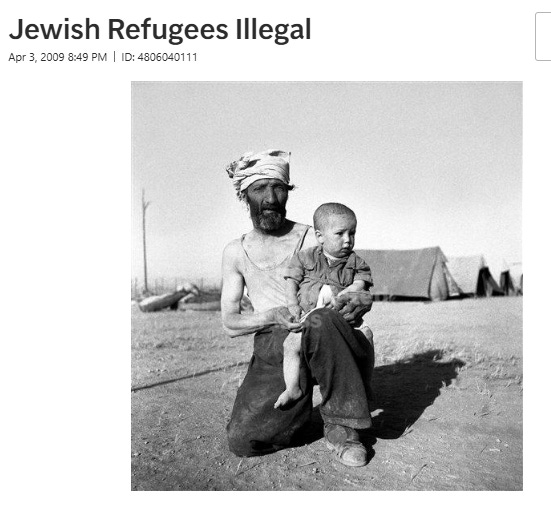
Israel Koperlov, 1½ years of age, on the knee of his father, Chaim Koperlov, awaiting sunset check by Legion guards on June 4, 1948, in Trans-Jordan. (AP Photo/Daniel De Luce)
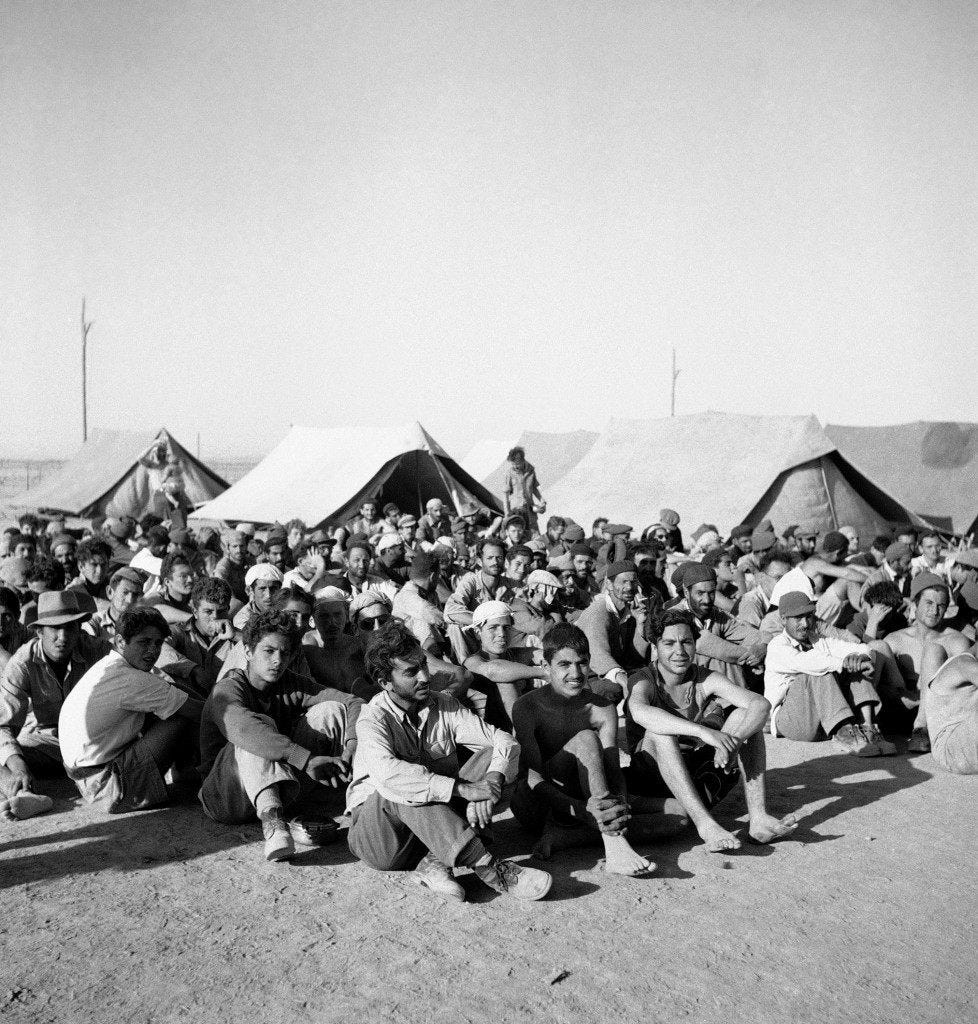
Joshua Cohen, 12, one of nearly 300 prisoners taken by the Trans-Jordan Legion on the surrender of the Old City Jewish quarter, Jerusalem, and now held in Trans-Jordan. He is seated on the ground with other prisoners for sunset check by Legion guards on June 4, 1948, in Trans-Jordan. (Associated Press Photo/ Daniel De Luce)
Almost 700 prisoners - Jewish civilians and combatants - were captured and incarcerated in Transjordan. The International Committee of the Red Cross archive records changes in the prisoner population with unusual precision. ICRC delegate Jean Courvoisier visited Mafraq (Umm al-Jamal) on June 4, 1948, and produced a list of 639 Jewish prisoners. A later list counted 670 in Arab Legion hands - 663 at Mafraq and seven hospitalized at Zarqa. By September-October, the camp list had risen to 682. Immediately before repatriation, another ICRC file listed 681 prisoners at Umm al-Jamal. The number changed as women and wounded prisoners were released, new prisoners arrived, and men moved between hospitals and the camp.
The largest initial group came from Gush Etzion, the bloc of Jewish communities south of Jerusalem. Israeli historical accounts tally about 320 prisoners from Ein Tzurim, Massuot Yitzhak, Revadim, and the surviving remnant of Kfar Etzion. About 240 Jews were killed in the fighting for Gush Etzion. The 320 prisoners included dozens of women and wounded. The number of women varies by source: one account lists 83 women among the 320, while a later article in the IDF journal Maarachot lists 89 women in Jordanian captivity - 86 from Gush Etzion and three from Naharayim.
Jerusalem supplied the other large group of prisoners. When the Jewish Quarter surrendered on May 28, 1948, the American vice consul reported the terms the following morning: approximately 2,000 women, children, elderly people, and religious Jews were to be evacuated under Red Cross supervision; 300 “men of military age” were to be taken as prisoners of war to Amman; the slightly wounded would also become POWs, while the seriously wounded would pass into Red Cross care.
“Men of military age” did not mean “combatants.”
That wording is the key to the civilian question. Later Israeli accounts estimate that the Jerusalem contingent included roughly 50 fighters and about 290 civilians. Whatever the exact division, the Associated Press and Red Cross photographs, together with contemporary captions, establish a basic point: the Legion’s captive population was not limited to soldiers.
Historian Benny Morris breaks down these numbers further: 341 people were taken from the Jewish Quarter: 290 healthy males and 51 wounded; approximately two-thirds of the 290 healthy males were noncombatants, some young and some elderly. The selection criterion was not based on combat participation.
His sources for that passage are:
A Twelve-Year-Old Prisoner of War
Associated Press correspondent Daniel De Luce reached the prisoners in Transjordan on June 4, 1948. He photographed Joshua Cohen, age twelve, seated with the captives for the sunset roll call. The AP caption is explicit: Cohen was “one of nearly 300 prisoners” taken when the Old City’s Jewish Quarter surrendered. The photograph’s AP reference number is PA.7091311.
De Luce also photographed one-and-a-half-year-old Israel Koperlov on the knee of his father, Chaim Koperlov, as they awaited the same roll call. The child was plainly not a combatant. His presence among the captives is another reminder that the population held by the Legion cannot be understood simply as a body of soldiers taken on the battlefield.
Why the AP photographs were later filed under the heading “Jews refugees illegal” remains unclear. The label may have been a later cataloging error rather than De Luce’s original description. Without AP’s cataloging history, it would be unsafe to attribute the phrase to De Luce, the Arab Legion, or the British officers serving with it. What is certain is that the label was historically incorrect and made the photographs harder to recognize for what they were. One pro-Arab publication took a De Luce photo of old Jewish men and wrote this outlandish caption: Legion guards with two orthodox Jews who preferred imprisonment in Trans-Jordan (sic) to going into Jewish-held area of Jerusalem, which is also still a battle zone.
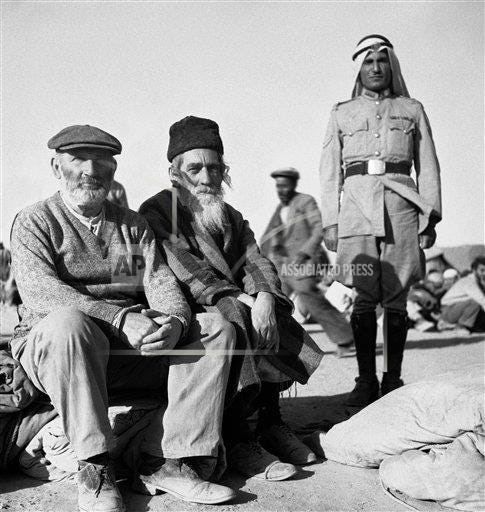
The roughly 700 Jewish prisoners of 1948 were not a single military unit, and they should not be remembered as one. They were most certainly not “illegal refugees.” They were fighters and civilians, women and men, children and elders, religious Jews and secular kibbutzniks, healthy prisoners and wounded patients. Jordan held them under a common designation, but the photographs restore the distinctions that designation concealed. At that point, the photographs cease to be mere illustrations. They become historical testimony.
Author’s postscript: In my research into the POW camp’s administration, I found that prisoners were assigned to kitchen duty, policing the camp, writing the prisoners’ newspaper, and administrative work. Among the assignments was an “outside liaison” task given to a prisoner from Ayn Tzurim, Eliyahu Bar Chama. Years later, I met Eliyahu in a Canadian Jewish camp, Moshava. I was a little kid, and Eliyahu was the emissary (shaliach) for the Bnai Akiva youth organization. He and his family instilled in my siblings, my cousins, and me a deep, intense love for Israel. Our families remain in touch to this day. If author Leon Uris (né Yerushalmi) returned to life and wrote a sequel, he would write his next book about the Bar Chama clan.
Thank you for posting this information.
Below is additional data of that war:
Kfar Etzion 1948 War
The Kfar Etzion massacre occurred on May 13, 1948, resulting in the deaths of 127 defenders and residents of the kibbutz. The vast majority of them were murdered after surrendering and being taken prisoner by the Jordanian Arab Legion and local irregular forces.
Background and Timeline of Events
• Date of Fall: The Etzion Bloc (Gush Etzion) fell on May 13, 1948, just one day before the Israeli Declaration of Independence.
• The Attackers: The final assault was carried out by the Arab Legion alongside local armed villagers and irregular forces.
• The Massacre: After the defenders surrendered, the survivors (including many wounded) were gathered in a central courtyard. An order was given—or an armed mob junto with soldiers broke out—and opened fire, executing dozens of defenseless prisoners of war.
• The Survivors: Only four individuals managed to survive the battle and the subsequent massacre.
The Four Survivors and Their Escapes
Only three Kfar Etzion residents and one Palmach member managed to survive the horrific massacre. According to historical records and their own testimonies, they escaped through the following circumstances: [1]
• Yaacov Edelstein and Yitzhak Ben-Sira: The two men initially attempted to evade capture by hiding among a jumble of boulders and tree branches. They were discovered by an elderly local Arab villager who told them not to be afraid and attempted to shield them from a rushing group of hostile Arab irregulars. As an argument ensued, two uniformed Jordanian Arab Legionnaires stepped in, took Edelstein and Ben-Sira into their custody, and preserved their lives as prisoners of war. [1]
• Nahum Ben-Sira: The brother of Yitzhak Ben-Sira, Nahum was separated from the main group of defenders when the killings began. He successfully hid undetected until nightfall and managed to escape on foot through the terrain to a nearby kibbutz. [1, 2]
• Alisa Feuchtwanger: A female member of the Palmach elite fighting force, Feuchtwanger hid in a ditch alongside several other defenders. The group was discovered, and everyone was killed except for her. She was dragged away by irregular militiamen who attempted to assault her. A Jordanian Arab Legion officer, Captain Hikmat Mihyar, arrived on the scene, shot two of the attackers, and took her under his personal protection, saving her life. [1]
Aside from these four, the remaining survivors of the broader battle for the Etzion Bloc were taken into Transjordan as prisoners of war. [3]
The Return of the Victims' Remains
Following the massacre and the total destruction of the kibbutz, the bodies of the fallen were left exposed at the site for over a year. Transjordanian forces initially refused to allow Israelis access to recover them. [3]
• The November 1949 Expedition: In late 1949, following negotiations and assistance from the Red Cross, an official agreement was reached with the Jordanians. IDF Chief Rabbi Shlomo Goren was permitted to lead an expedition into the former Etzion Bloc to collect the remains. [4]
• Condition of the Site: Rabbi Goren documented that contrary to initial Red Cross reports, the Arab forces had not buried the dead. The bones of the victims were found scattered across trenches, firing posts, and underneath the ruins of demolished buildings. Many bodies were identified only by clothing scraps and laundry tags still bearing the names of their owners. [4]
• Mass Re-interment: The remains of the fallen defenders of Kfar Etzion, alongside soldiers recovered from other battlefields left behind enemy lines, were transported back to Israel. In November 1949, tens of thousands of citizens lined the streets as the victims were brought to a massive, state-honored funeral and buried in a mass grave at Mount Herzl Military Cemetery in Jerusalem. [4, 5]
[1] https://en.wikipedia.org
[2] https://www.wexnerfoundation.org
[3] https://jewishvirtuallibrary.org
[4] https://www.tabletmag.com
[5] https://www.telfed.org.il