

A version of the author’s essay appeared in the book American Interests in the Holy Land Revealed in Early Photographs.
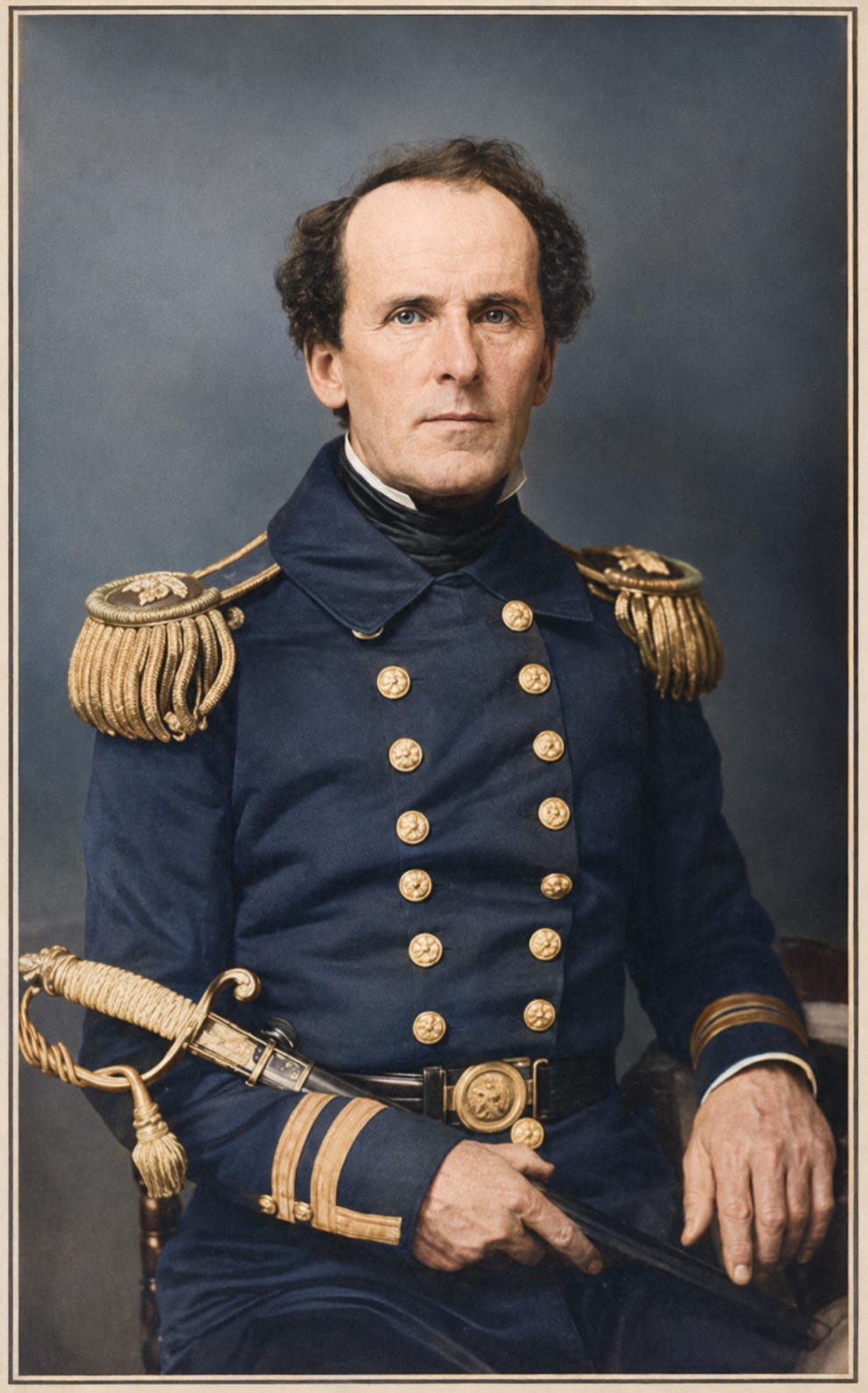
William Francis Lynch (1801–1865) was a naval officer who served in both the United States Navy and, later, the Confederate Navy. In the 1840s, he proposed that the United States government sponsor an expedition to the Holy Land to explore and map the Jordan River and the Dead Sea.
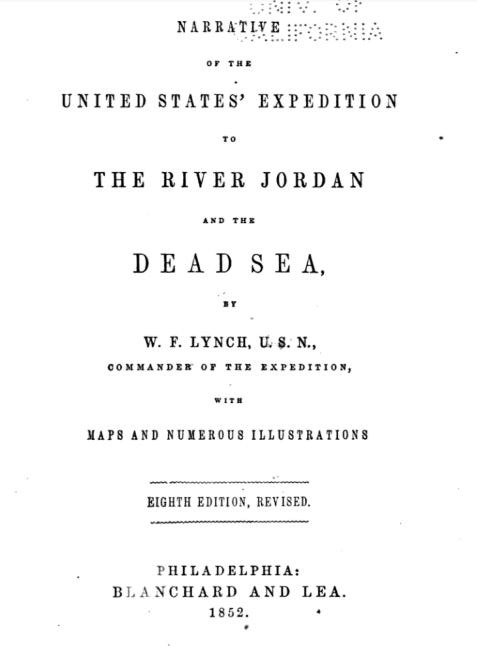
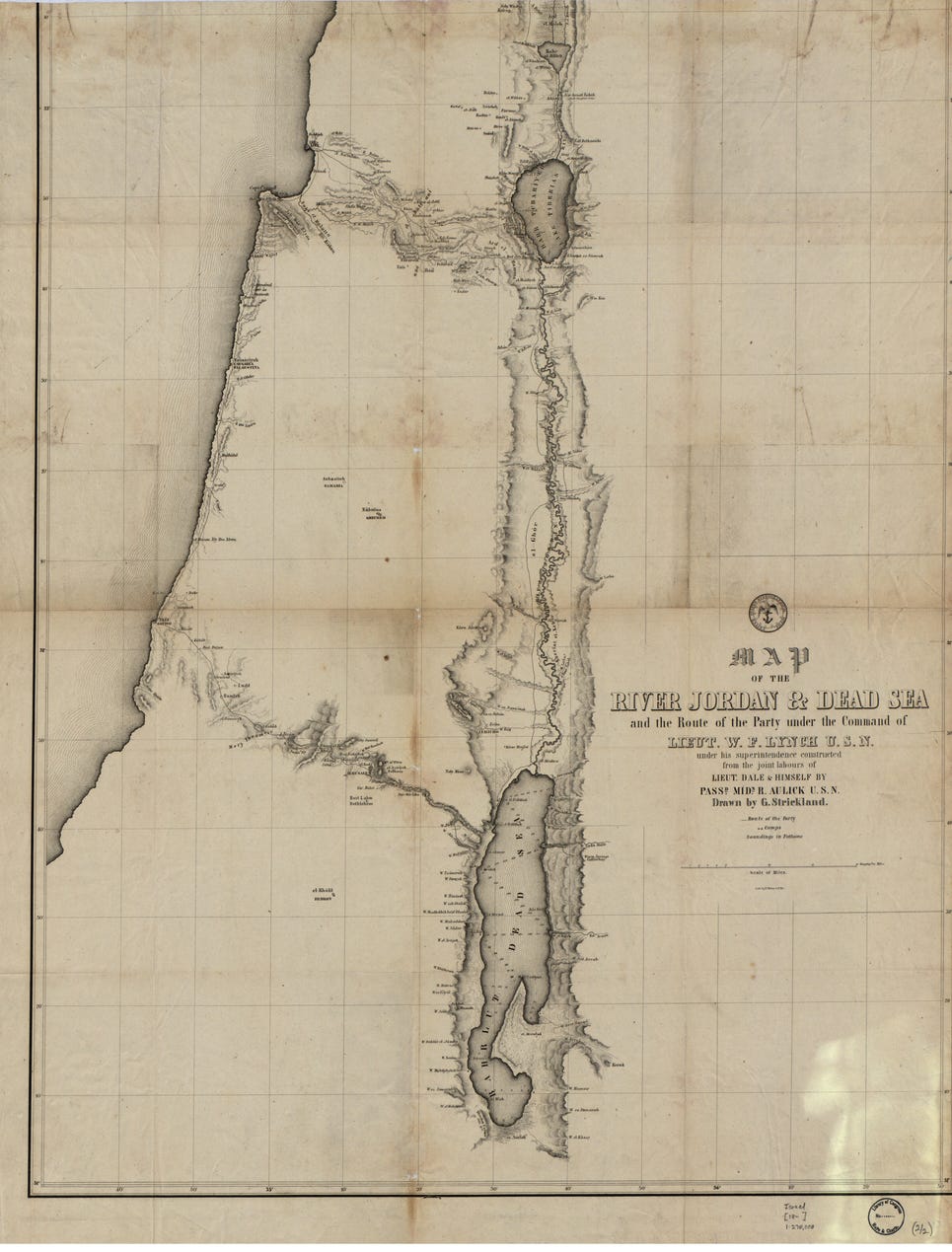
Lynch carried out the mission in 1847 with a crew of 16 sailors. He later published his findings in Narrative of the United States’ Expedition to the River Jordan and the Dead Sea. Photography was not yet available for such field documentation, so Lynch and his crew relied on illustrations to accompany the expedition record.
Lynch’s motives appear to have been patriotic, religious, and scientific. He wrote:
“We [Americans] owe something to the scientific and Christian world, and while extending the blessing of civil liberty in the south and west [otherwise known as ‘Manifest Destiny’], may well afford to foster science and strengthen the bulwarks of Christianity in the east.”
Lynch was also a strong adherent of “Restorationism,” a precursor to Christian Zionism. Restorationists believed that the Jewish people must return to the Holy Land as part of the fulfillment of biblical prophecy and the anticipated Second Coming. This belief influenced many Americans, including some presidents, who later advocated establishing a Jewish homeland.
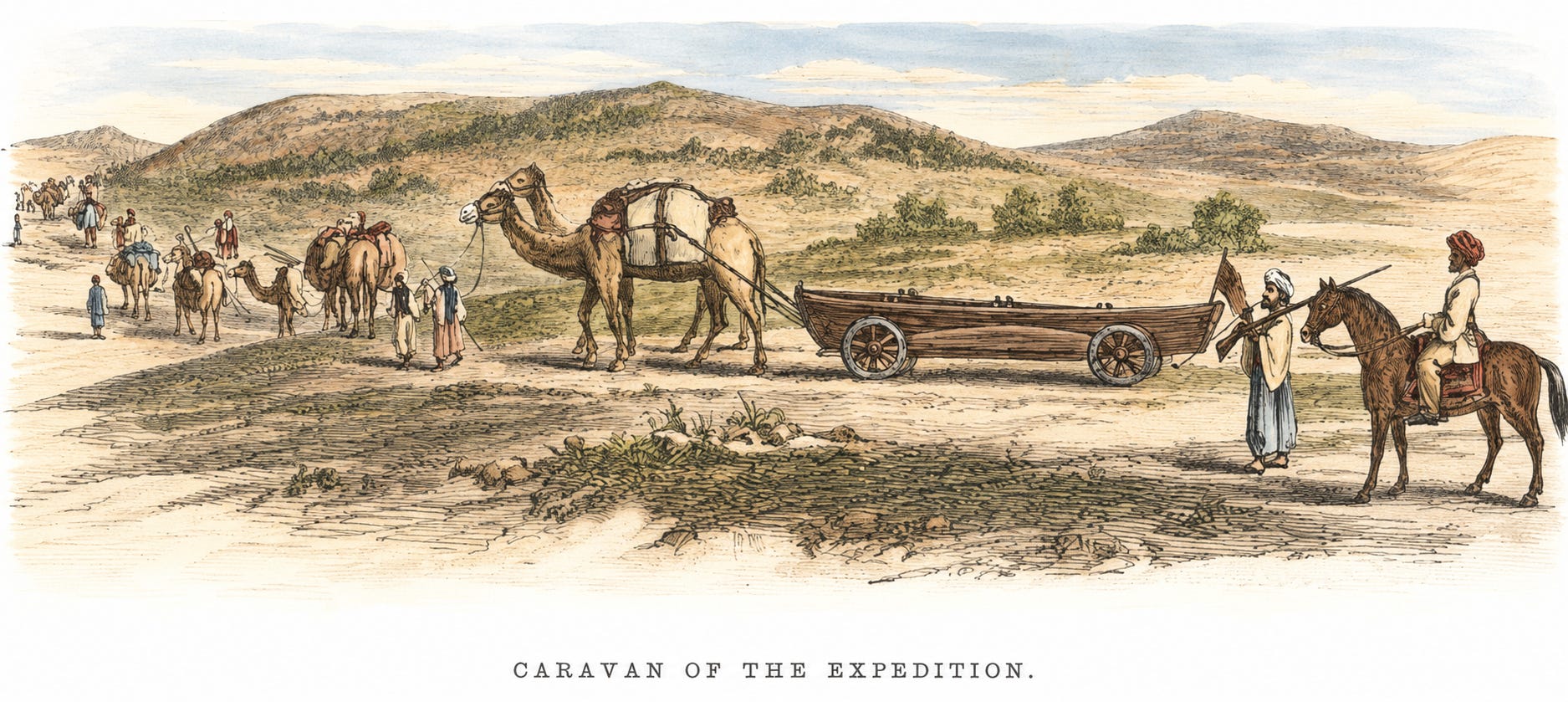
Along his route, Lynch described the Jordan River’s raging rapids, difficult terrain, unusual flora and fauna, warring Arab tribes, and suffering Christian and Jewish communities. He also visited the Jewish community of Damascus.
The U.S. Navy Met the Jewish of Tiberias
Lynch’s 175-year-old description of the Jews of Tiberias is remarkable. He wrote that the community numbered approximately 1,000 Jews and was led by a “Sanhedrin,” a religious court of rabbis. That detail is especially striking because Jewish sages in Safed and Jerusalem had fiercely debated in the 1500s whether to reestablish the Sanhedrin of the Temple period. As far as we know, they did not succeed, and no universally recognized Sanhedrin has been convened to this day.
Lynch: Safed and Tiberias, Jerusalem and Hebron, are the four holy cities of the Jews in Palestine. Tiberias is held in peculiar veneration by the Jews, for here they believe that Jacob resided, and it is situated on the shores of the lake whence the Jews hope that the Messiah will arise.
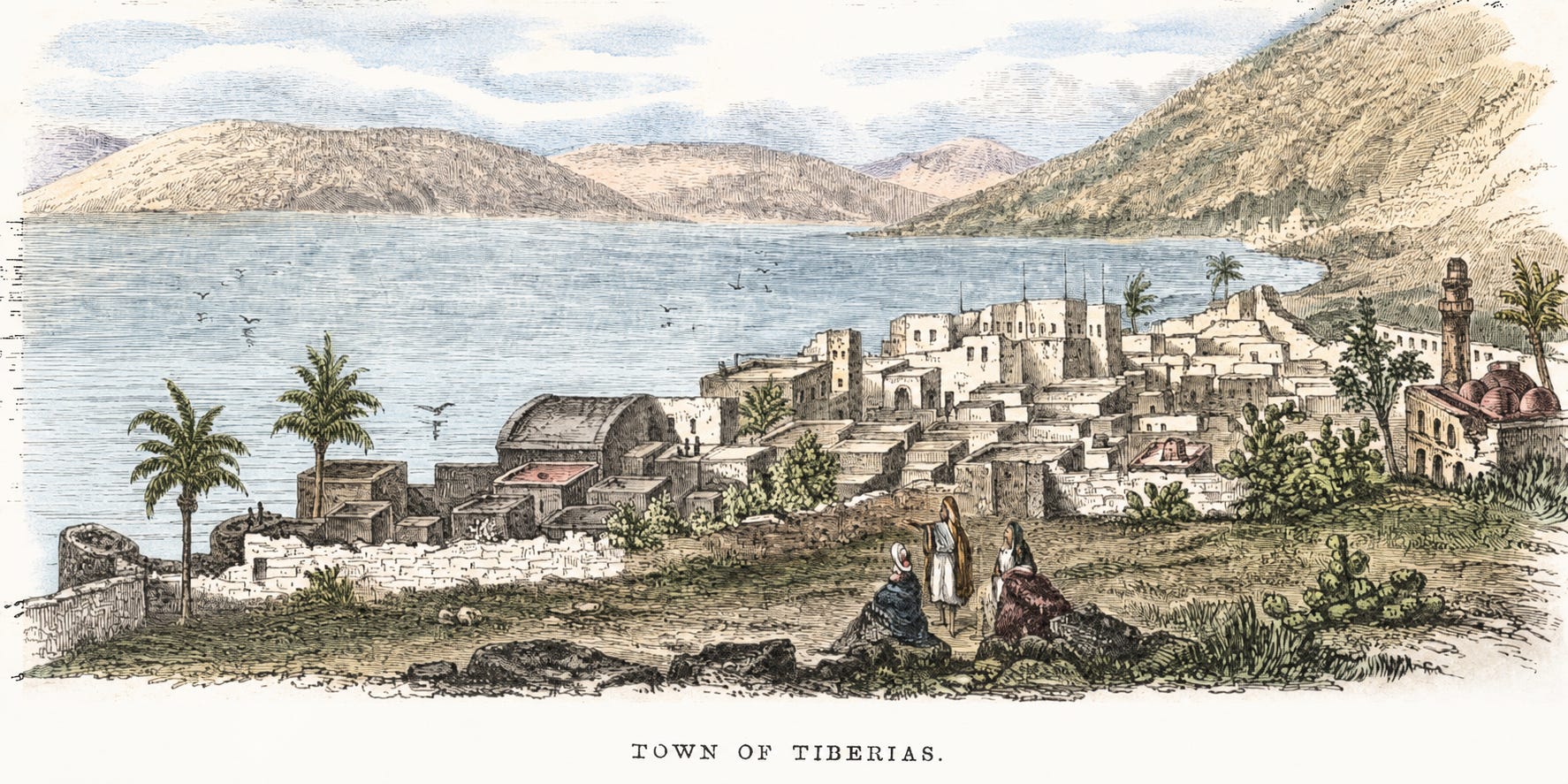
Winding down the rugged road, we descended to the city, seated on the margin of the lake. Tiberias (Tubariyeh) is a walled town of some magnitude, but in ruins, from the earthquake which, in 1837, destroyed so many of its inhabitants.
We had letters to the chief rabbi of the Jews, who came to meet us, and escorted us through labyrinthine streets to the house of Heim Wiseman, a brother Israelite. It is a hotel sui generis, as well in the mode of entertaining as in the subsequent settlement with its guests.…
A trifling circumstance will show in what thraldom the Jews are held. Our landlord, Heim Wiseman, had been kind enough to show me the way to thegovernor'ss. On our entrance, he meekly sat down on the floor, some distance from the divan. After the sherbet was handed round to all, including many Arabs, it was tendered to him. It was a rigid fast-day with his tribe, the eve of the feast of the azymes [unleavened bread, i.e., Passover], and he declined it. It was again tendered, and again declined, when the attendant made some exclamation, which reached the ears of the governor, who thereupon turned abruptly round, and sharply called out, ‘Drink it.’ The poor Jew, agitated and trembling, carried it to his lips, where he held it for a moment, when, perceiving the attention of the governor to be diverted, he put down the untasted goblet.
Returned the visit of the Rabbis. They have two synagogues, the Sephardim and Ashkenazim, but live harmoniously together. There are many Polish Jews, with light complexions, among them. They describe themselves as very poor and are maintained by the charitable contributions of Jews abroad, mostly in Europe. More meek, subdued, and unpretending men than these Rabbis I have never seen.…
In the evening, we visited several of the synagogues. It was impressive yet melancholy to witness the fervid zeal of the worshippers. In gabardines, with broad and narrow phylacteries [probably prayershawls, and not tephillin], some of them embroidered, the men were reading or rather chanting, or rather screaming and shouting, the lamentations of Jeremias — all the time swaying their bodies to and fro with a regular and monotonous movement. There was an earnest expression of countenance that could not have been feigned. The tones of the men were loud and almost querulous with complaint; while the women, who stood apart, were more hushed in their sorrow, and lowly wailed, moving the heart by their sincerity. In each synagogue was an octagon recess (holy ark), where the Pentateuch and other sacred works were kept. Whatever they may be in worldly matters, the Jews are no hypocrites in the article of faith.
There are about three hundred families, or one thousand Jews, in this town. The Sanhedrin consists of seventy rabbis, of whom thirty are natives and forty Franks, mostly from Poland, with a few from Spain. The rabbis stated that controversial matters of discipline among Jews, all over the world, are referred to this Sanhedrin.
It needs but the destruction of that power which, for so many centuries, has rested like an incubus upon the eastern world, to ensure the restoration of the Jews to Palestine. The increase of toleration; the assimilation of creeds; the unanimity with which all works of charity are undertaken, prove, to the observing mind, that, ere long, with every other vestige of bigotry, the prejudices against this unhappy race will be obliterated by a noble and a God-like sympathy...the time will come. All things are onward; and, in God’s providence, all things are good. How eventful, yet how fearful, is the history of this people! The Almighty, moved by their lamentations, determined not only to relieve them from Egyptian bondage but to make them the chosen depositary of his law.